Presentations for categories of crystals
We give generators and relations for the monoidal categories of crystals generated by the fundamental crystals of a simple complex Lie algebra.
Theme song: A very unserious YouTube Short for this serious paper.
Data
- Title: Presentations for categories of crystals
- Authors: Moaaz Alqady, David He and Daniel Tubbenhauer
- Status: Preprint, 2026. 33 pages, many figures, comments welcome.
- Code and (possibly empty) Erratum: GitHub
- arXiv link: https://arxiv.org/abs/2606.02249
- MSC 2020: Primary: 17B10, 17B37; Secondary: 05E10, 18M05.
Abstract
We give generators and relations for the monoidal categories of crystals generated by the fundamental crystals of a simple complex Lie algebra. We also spell out several small-rank examples.
What is the point?
The guiding question is the old diagrammatic one: can one present a tensor category by pictures and local relations? For crystals the answer is unusually clean. Crystals are the \(q=0\) shadow of representation theory: they remember the combinatorics, but forget most of the linear algebra. This makes the categories easier, but also stranger, since braidings are replaced by coboundary structures and cactus-group behavior.
The paper gives a hands-on generator-relation presentation for categories of crystals. The generators are crossings and atoms, and the relations are explicit local rewriting rules. In the end every diagram can be rewritten into a sandwich form, giving bases of hom-spaces and, after inserting Jones-Wenzl projectors, matrix units.
A picture
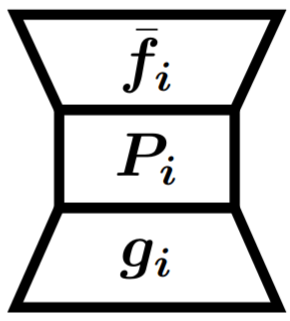
The three ingredients
These move fundamental crystals past one another. In the crystal world they are commutors rather than honest braidings in general.
These are the elementary crystal morphisms coming from the stable branching rules for tensoring with a fundamental crystal.
Relations rewrite diagrams into bottom diagram, permutation, top diagram form. This is the basis machine.
A few extra words
The usual web categories live at generic \(q\), with cups, caps, crossings and local relations. Crystal categories live at \(q=0\). They still have tensor products and natural commutors, but the structure is coboundary rather than braided. This paper connects these two diagrammatic stories.
The main theorem says that the category generated by the fundamental crystals is presented by crossings and atoms, modulo explicit local relations. These relations are constructive: the atoms are defined from crystal combinatorics, and the coefficients can be found by finite computation in crystals. Thus the theorem is not only a structural statement, but also an algorithm for producing presentations in examples.
The examples include \(\mathfrak{sl}_2\), \(\mathfrak{sl}_3\), \(\mathfrak{sp}_4\), \(G_2\), and related \(\mathrm{SO}_3\) and Motzkin cases. The moral is pleasantly brutal: at \(q=0\) much of the linear algebra disappears, but one has to organize the remaining combinatorics carefully.