Tensor powers of representations of (diagram) monoids
A computational and representation-theoretic study of how tensor powers grow for finite monoids, with diagram monoids as a main testing ground.
Data
- Title: Tensor powers of representations of (diagram) monoids
- Authors: David He and Daniel Tubbenhauer
- Status: preprint.
- Code and (possibly empty) Erratum: Click
- arXiv link: http://arxiv.org/abs/2508.04054
Abstract
We study tensor powers of representations of finite monoids, focusing on the growth behavior of their composition length and the number of indecomposable summands. Special attention is given to diagram monoids such as the Temperley--Lieb, Motzkin, and Brauer monoids. For these examples, we compute explicit data, including some character tables, and analyze patterns in the decomposition of their tensor powers.
What is the point?
The paper takes a familiar representation-theoretic question, what happens under repeated tensor product, and asks it for monoids rather than only groups. Diagram monoids provide concrete, computable examples where the answer mixes algebra, combinatorics and asymptotics.
Temperley–Lieb, Motzkin, Brauer and related diagram monoids.
Track composition length and indecomposable summands in tensor powers.
Explicit data, character tables and patterns for growth.
A picture
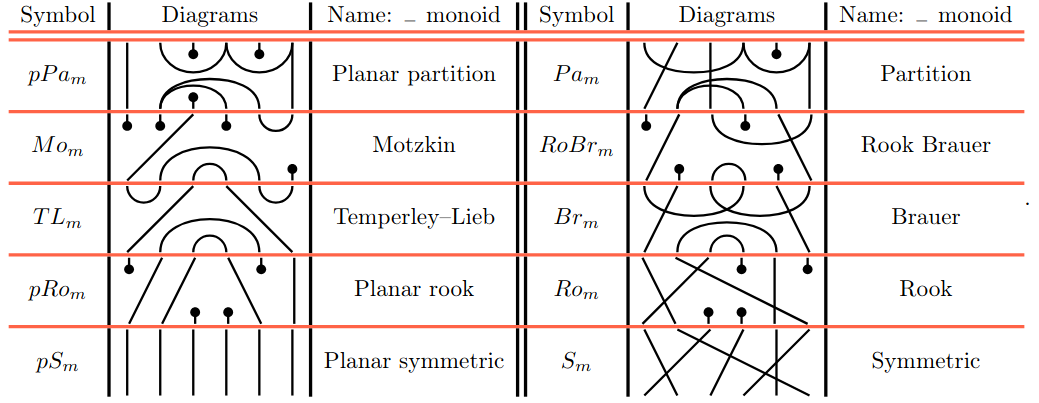
The main diagrammatic monoids under study.
A few extra words
The picture above shows the main diagrammatic monoids under study.
Let \(C\) be an
additive Krull–Schmidt monoidal category.
Let \(X\in C\) be an object of \(C\).
We define
\[
b_{n}=b_{n}^{C,X}:=\#\text{indecomposable summands in }X^{\otimes n}\text{, counted with multiplicities}.
\]
We identify the sequence \(b_{n}\) with its function \(n\mapsto b_{n}\). In the abelian setting, there is a similar definition for the length \(l_n\), that we will also use.
The functions \(l_n,b_{n}\) have been the subject of extensive study. In this paper we study them for monoids, in particular for diagram monoids as above.