Idempotents, traces, and dimensions in Hecke categories
A practical guide to computing idempotents, traces and categorical dimensions in Hecke and asymptotic Hecke categories.
Data
- Title: Idempotents, traces, and dimensions in Hecke categories
- Authors: Ben Elias, Liam Rogel and Daniel Tubbenhauer
- Status: preprint.
- Code and (possibly empty) Erratum: Click
- arXiv link: https://arxiv.org/abs/2507.10061
Abstract
We explain how to compute idempotents that correspond to the indecomposable objects in the Hecke category. Closed formulas are provided for some common coefficients that appear in these idempotents. We also explain how to compute categorical dimensions in the asymptotic Hecke category. In many cases, we reduce this to a computation of a partial trace and give recursive formulas for some common partial traces. In the sequel, we apply this technology and perform additional (computer) calculations to complete the description of the asymptotic Hecke category for finite Coxeter groups in all but three cells.
What is the point?
Indecomposable objects in Hecke categories are controlled by idempotents. This paper explains how to compute them, how to take the traces that matter, and how to turn diagrammatic formulas into dimensions. The goal is not just formalism: it is a computational toolkit for asymptotic Hecke categories.
Explicit formulas for coefficients in common cases.
Partial traces reduce categorical dimensions to manageable calculations.
The paper is designed as technology for larger Hecke-category calculations.
A picture
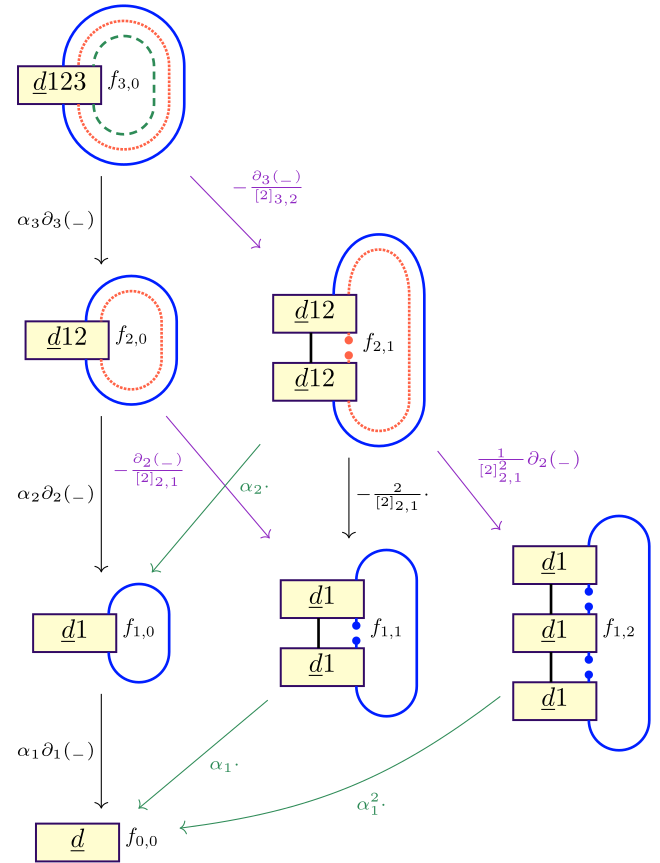
A typical Hecke-category idempotent calculation.
A few extra words
This paper is a user's guide about Idempotents in Hecke categories, with fancy pictures like the above.