The subregular and submaximal \(p\)-cells
A uniform description of the first nontrivial \(p\)-cells at the two ends of the two-sided cell order, with explicit \(p\)-Kazhdan–Lusztig formulas in classical type and computational results in exceptional type.
Theme song: coming soon.
Data
- Title: The subregular and submaximal \(p\)-cells
- Authors: Vanessa Miemietz, Marie Roth and Daniel Tubbenhauer
- Status: preprint from 2026
- Code, data and (possibly empty) Erratum: GitHub
- arXiv: https://arxiv.org/abs/2608.19798
- Theme song: coming soon
- Keywords: Kazhdan–Lusztig cells, \(p\)-cells, \(p\)-canonical basis, subregular cell, submaximal cell, Hecke categories, Soergel bimodules, parity sheaves
Abstract
Cells for the canonical and \(p\)-canonical bases organise the representation theory and geometry of Hecke categories. We determine the relevant \(p\)-canonical basis elements and the resulting \(p\)-cell structure for the subregular and submaximal cells in all Weyl types.
What is the point?
The \(p\)-canonical basis can differ from the usual Kazhdan–Lusztig basis in positive characteristic, and this can reorganise the cells of a Hecke category. We study the first nontrivial cells at the two ends of the ordinary two-sided cell order and give uniform descriptions in arbitrary classical rank, together with exceptional-type computations.
explicit relevant \(p\)-Kazhdan–Lusztig basis elements and two-sided \(p\)-cells.
the subregular and submaximal cells split in types \(B\) and \(C\), in different ways.
computer calculations for the subregular cells, and also the submaximal cells in \(G_2\) and \(F_4\).
Picture
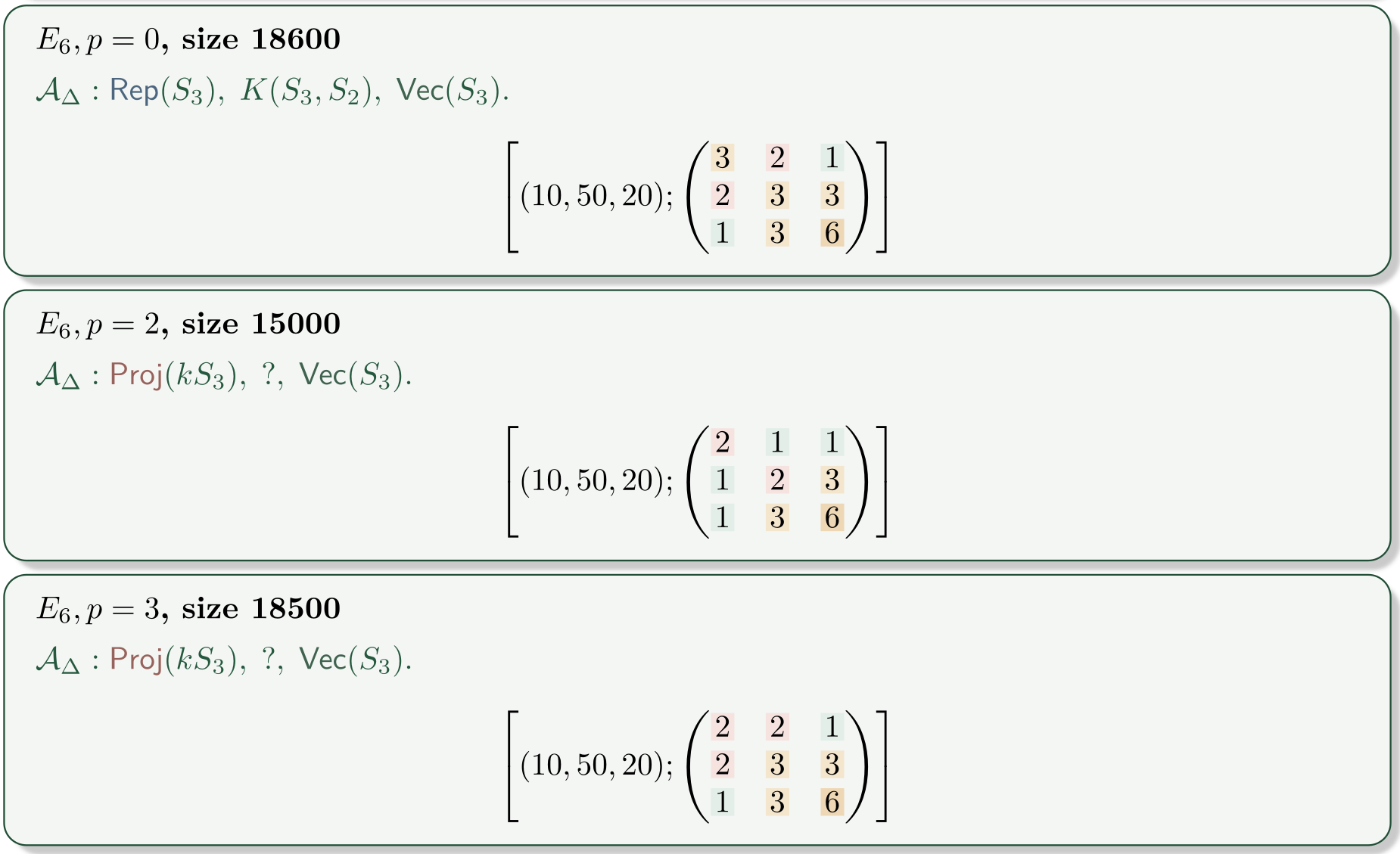
A sample of the exceptional-type computations: low-rank \(p\)-cell data in type \(E_6\), including characteristic-dependent cell sizes and intersection matrices.