Games and gamification
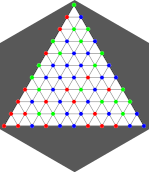
Human intuition. Machine scale. Gamification is where they meet.
The idea is not to make mathematics less serious. The idea is to turn a mathematical search into something people can touch, drag, restart, and play with. A good game records choices: where humans pull, where they hesitate, where they try a strange detour, and where they find a route an automated search might not prioritize.
For me, gamification is a way of collecting structured human intuition. People explore. Computers multiply the search. Mathematics filters what survives.

Current status
Unknot! is released on Steam, with the public game page, demo, reviews, achievements, and the usual Steam infrastructure around it.
The important part for us is already happening: play produces data. Routes, attempts, restarts, and choices can become a pool of human unknotting intuition.
The plan is to use the Tokyo Game Show 2026 appearance to collect substantially more player data, especially from people encountering the puzzles in a natural game setting.
The public-facing game: clean controls, chalkboard style, and a simple promise—turn a knot into something unknotted.
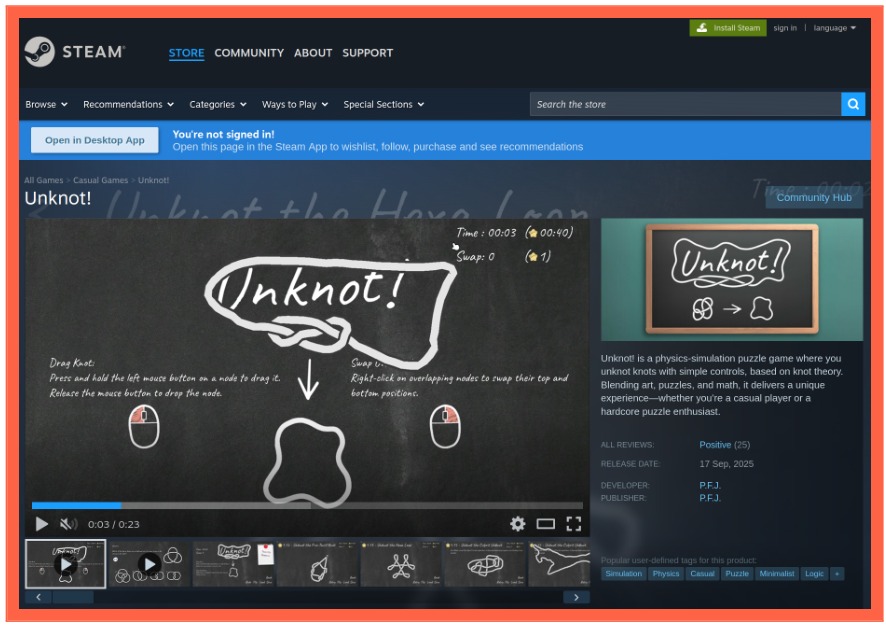
The Steam page is useful because it gives the experiment a public home and a natural way to reach players.
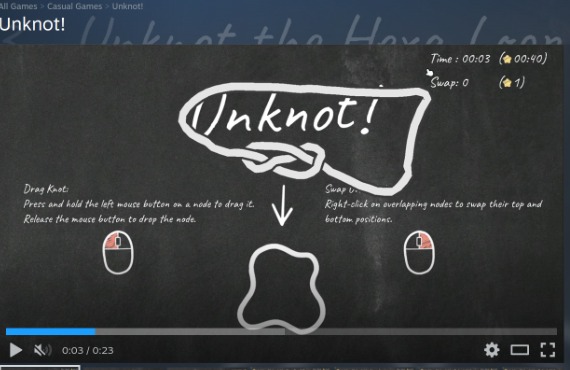
The useful research object is not just the final solved state, but the route a player takes through the puzzle.
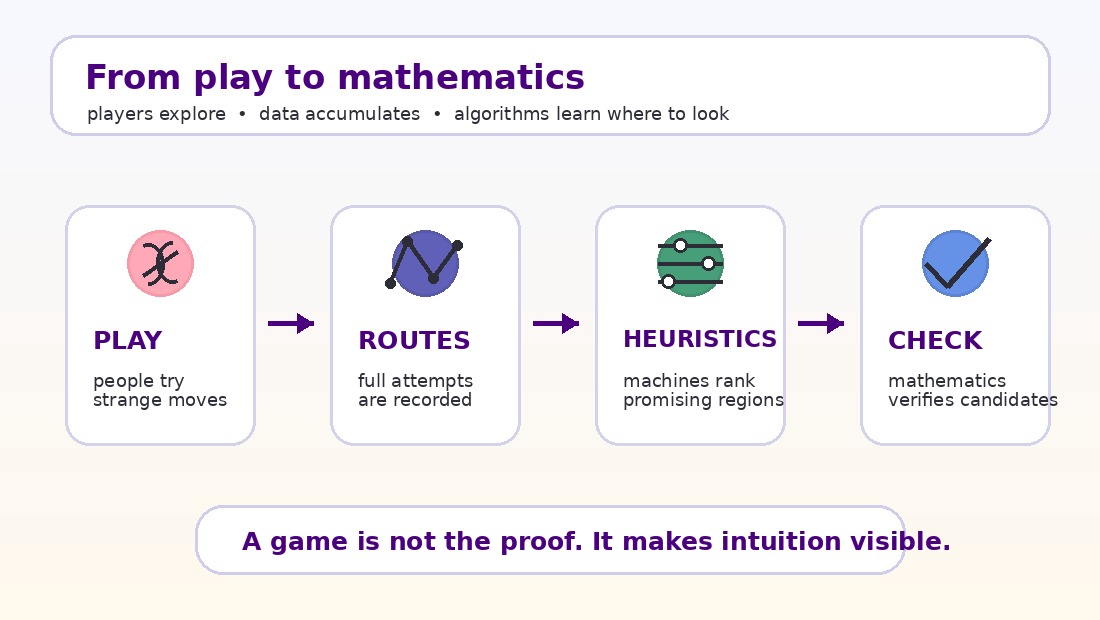
The general loop: play records intuition, data suggests heuristics, and the mathematical pipeline checks candidates.
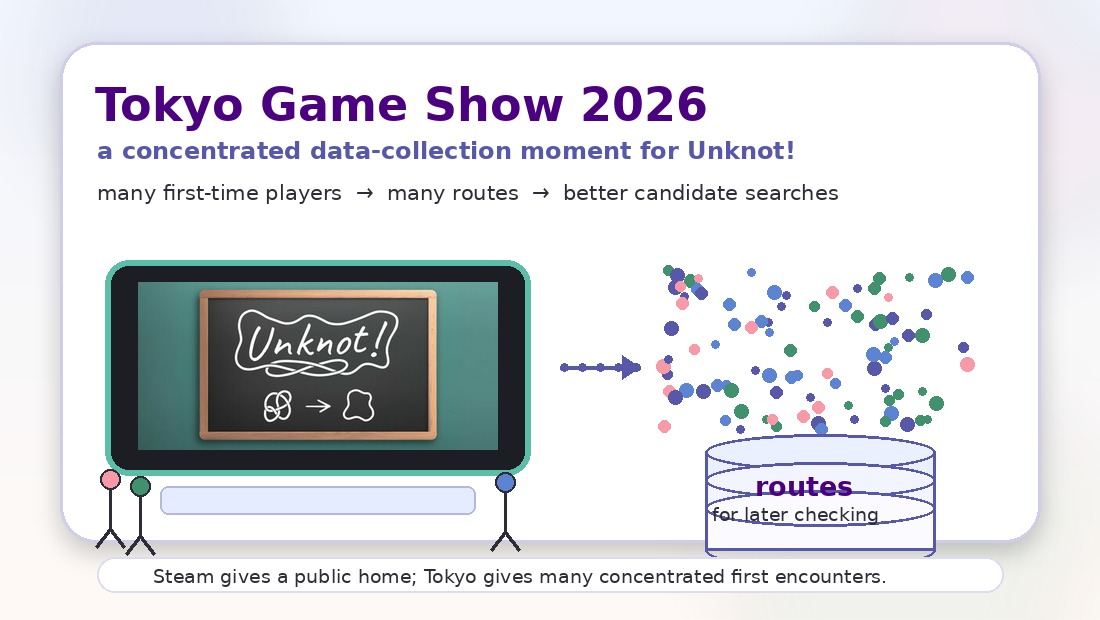
A better Tokyo image for this page: not a generic convention picture, but a data-collection moment for Unknot!.
General strategy
The loop
- Choose a hard search problem. It should have many local moves and a global goal that is hard to see from the current position.
- Make the local moves playable. The player should feel the problem before they read the theory behind it.
- Record the route. Not only success: also failed attempts, backtracking, pauses, and tempting wrong moves.
- Turn play into heuristics. Many human attempts suggest where a machine search should look first, or what it should not waste time on.
- Check independently. A game can suggest mathematics, but it cannot certify it by itself. Serious output needs a separate mathematical or computational check.
Why games?
- Humans are excellent at pattern guesses that are hard to formalize.
- Games generate many attempts without asking players to write formal mathematics.
- The failed routes are often as valuable as the successful ones.
- Computers can aggregate, compare, clean, and rerun the promising attempts.
- The mathematical pipeline can then decide which guesses are real.
Human intuition
Players try moves because they feel right, not because they fit a predefined search heuristic.
Machine scale
Computers can collect many attempts, compare them, rerun them, and turn them into better searches.
Mathematical filter
The end result must be a clean candidate route that survives independent verification.
Specific example: Unknot!
Unknot! is a physics-simulation puzzle game about unknotting. The public game is simple to understand: interact with a tangled rope and try to turn it into something unknotted.
The research experiment is more specific. We are exploring whether player intuition can help find new unknotting routes. A player may pull in a strange place, try a visually unnatural crossing change, or temporarily make the diagram look worse. Those are exactly the kinds of moves that are easy to miss in a purely local search.
If a player-inspired route gives a better upper bound for an unknotting number, and if existing lower bounds match after independent verification, then the experiment can contribute a new exact unknotting number.
What the data should tell us
From play to candidates
- which local moves humans try first;
- which crossings or regions attract attention;
- which detours are common before a successful simplification;
- which failed routes repeatedly mislead players;
- which player routes suggest new upper bounds.
From candidates to mathematics
- reconstruct the route in a clean knot-diagram model;
- remove artifacts of the physics engine;
- check the crossing changes and simplifications independently;
- compare with known lower bounds;
- turn successful routes into publishable mathematical evidence.
Why Tokyo matters
Steam gives the project a public home and ongoing play data. Tokyo Game Show 2026 should add something different: many concentrated first-time encounters with the game, from players who are not preselected by mathematical interest. That is useful because the goal is not only to test whether experts can solve hard examples. The goal is to see what ordinary players try when the mathematical problem has been turned into play.
More players means more routes. More routes means better heuristics. Better heuristics may lead to new unknotting routes and, in favorable cases, new unknotting numbers.
Caveat
A physics-based game is not a proof environment. The game can collect intuition and suggest candidate moves, but anything mathematically serious has to be reconstructed and checked outside the game. That separation is a feature: play generates ideas; mathematics decides which ideas count.