On detection probabilities of link invariants
A quantitative study of how often standard link invariants distinguish links, and why detection becomes asymptotically rare.
Video
Data
- Title: On detection probabilities of link invariants
- Authors: Tuomas Kelomäki, Abel Lacabanne, Daniel Tubbenhauer, Pedro Vaz and Victor L. Zhang
- Status: preprint.
- Code / errata: ClickClick
- arXiv: https://arxiv.org/abs/2509.05574
- Slides: Slides 1Slides 2
Abstract
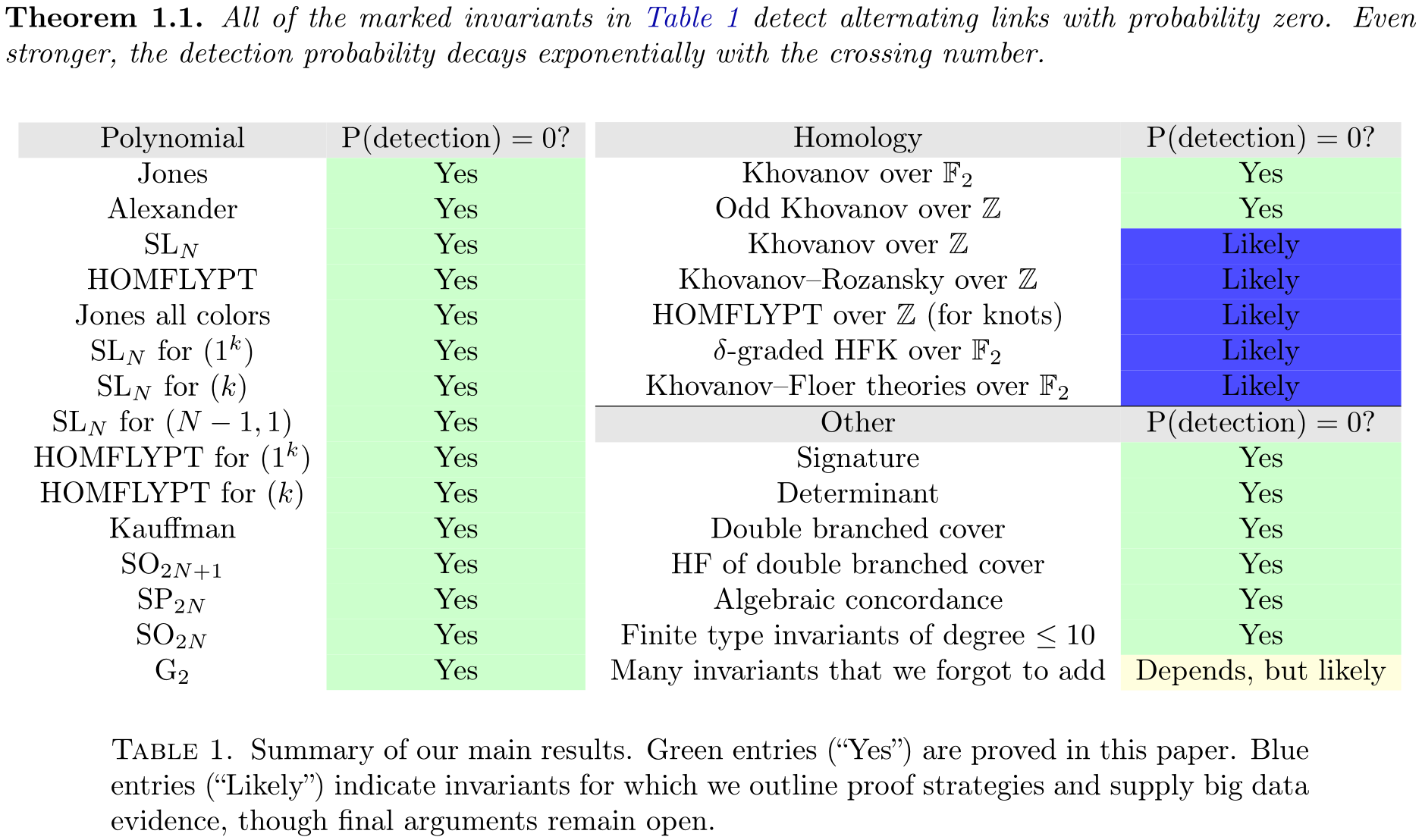
We prove that the detection rate of n-crossing alternating links by many standard link invariants decays exponentially in n, implying that they detect alternating links with probability zero. This phenomenon applies broadly, in particular to the Jones and HOMFLYPT polynomials and integral Khovanov homology. We also use a big-data approach to analyze knots and provide evidence that, for knots as well, these invariants exhibit the same asymptotic failure of detection.
What is the point?
Knot invariants are designed to tell knots and links apart. This paper asks a statistical version of that question: if links become large, what is the probability that a standard invariant detects the difference? The answer is sobering and useful: for many invariants the probability goes to zero exponentially.
Jones, HOMFLYPT, Khovanov, ...
large-scale link and knot data.
detection becomes rare.
More details
Here is the essentially self-explanatory main result: