Exponentially large mu-coefficients
The leading coefficients of Kazhdan–Lusztig polynomials for symmetric groups grow at least exponentially with the rank. Three rows already suffice.
Data
- Title: Exponentially large mu-coefficients
- Authors: Tom Goertzen, Abel Lacabanne, Daniel Tubbenhauer and Pedro Vaz
- Status: Preprint, 2026. Comments welcome.
- arXiv: TBA
- Journal: TBA
- DOI: TBA
- MSC 2020: Primary: 20C08, 20C30; Secondary: 05E10, 17B37.
Abstract
We prove that Kazhdan–Lusztig mu-coefficients for symmetric groups grow at least exponentially with the rank, already for pairs lying in a common left cell labeled by a three-row rectangle.
What is the point?
Kazhdan–Lusztig polynomials attach integers to pairs of permutations. Their mu-coefficients are the coefficients in the highest degree allowed by the degree bound, and give the edge weights in the cell W-graphs. For a long time, they were expected to be only zero or one. Counterexamples were found, but the question of whether they stay bounded in finite type A remained open.
We construct explicit pairs in the symmetric group on \(12+18r\) letters with mu-coefficient \(2^r\), for every \(r\geq 0\). Each pair lies in a common left cell labeled by the three-row rectangle \((4+6r,4+6r,4+6r)\). So even three rows already give exponential growth.
The first picture
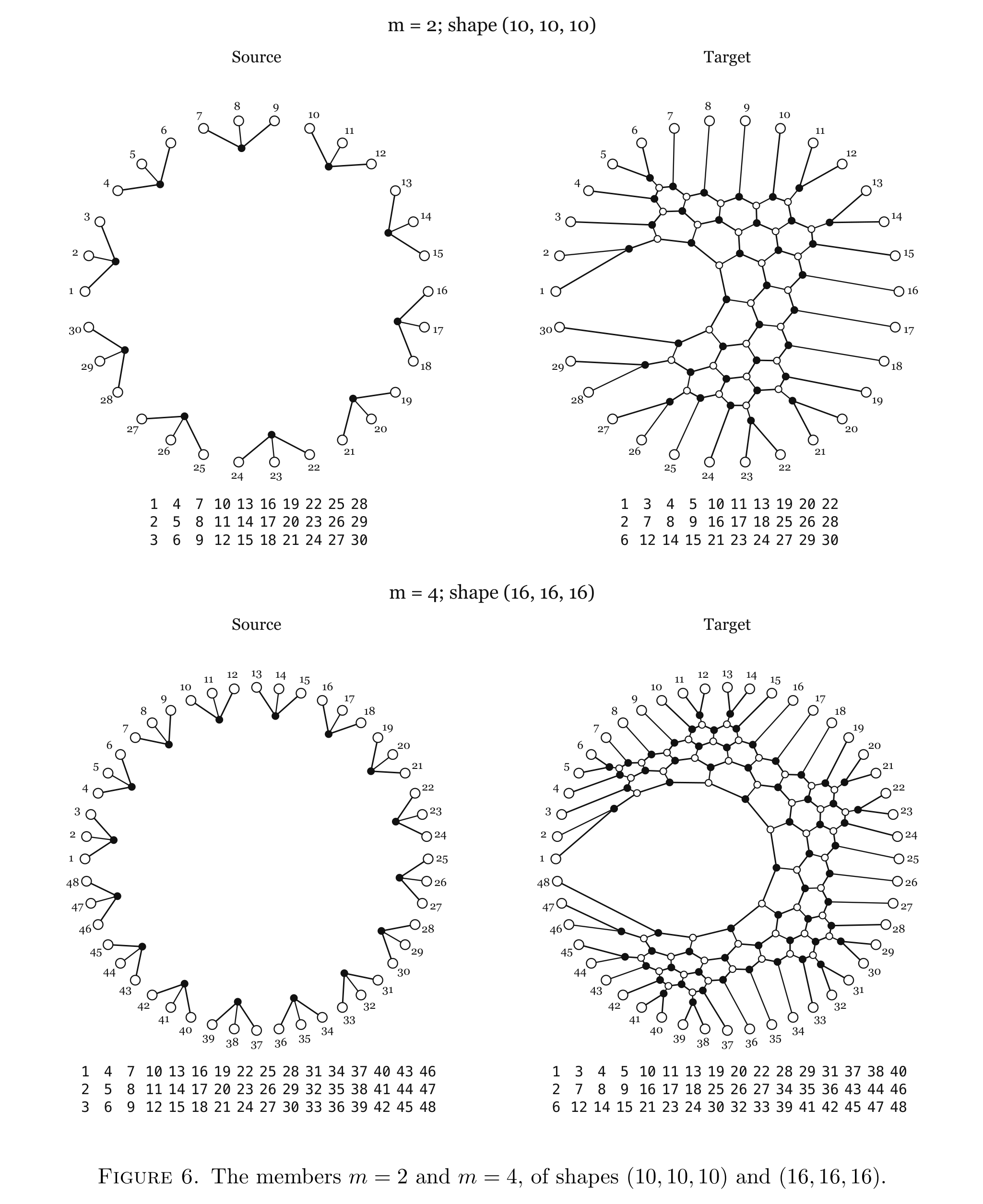
Figure 6 from the paper. The upper pair gives \(\mu=2\) in \(S_{30}\); the lower pair gives \(\mu=4\) in \(S_{48}\). Click the picture to open the corresponding page of the PDF.
Structural snapshot
The three ingredients
Put hexagon-in-hexagons patches next to one another, join them along three strands, and attach fixed end pieces.
The raw web is not the dual canonical vector. We add correction terms to each block while keeping the connecting tensor space at dimension 28.
Local degree bounds prove canonicality. A two-state calculation then shows that adding two blocks doubles the required coefficient.
A few extra words
The contrast with two-row shapes is striking: within those left cells, all mu-coefficients are zero or one. Our three-row family has values \(1,2,4,8,\ldots\), in \(S_{12},S_{30},S_{48},S_{66},\ldots\).
The proof uses webs for \(\mathfrak{sl}_3\) and the dual canonical basis to compute ordinary Kazhdan–Lusztig coefficients. Although the diagrams grow, the space connecting successive blocks has dimension \(27+1=28\), independent of the number of blocks. This is what makes the calculation finite.
Code and extras
- Code: GitHub repository, with the Lean verification and the W-graph programs used to find examples.
- Erratum: On GitHub.
- Theme song: TBA
- Talks and videos: TBA