Torsion proliferation
For any fixed prime \(p\), as the rank grows, almost every intersection cohomology sheaf on a classical full flag variety has \(p\)-torsion in its stalks or costalks, and almost every indecomposable parity sheaf is not perverse.
Data
- Title: Torsion proliferation
- Authors: Joseph Baine and Daniel Tubbenhauer
- Status: Preprint, 2026. Comments welcome.
- Code and data: GitHub
- arXiv: https://arxiv.org/abs/2609.31781
- MSC 2020: Primary: 14M15, 20C08; Secondary: 05A05, 60C05.
Abstract
This paper considers the generic behaviour of sheaves supported on Schubert varieties in finite flag varieties. Our main results are that, for any fixed prime \(p\), as the rank of the associated algebraic group grows, almost every intersection cohomology sheaf admits \(p\)-torsion in its stalks or costalks, and almost every indecomposable parity sheaf is not perverse. For certain families of partial flag varieties we also determine explicit asymptotics for this growth.
What is the point?
In modular representation theory, \(p\)-torsion in the stalks or costalks of integral intersection cohomology is exactly what makes the \(p\)-Kazhdan–Lusztig basis differ from the ordinary Kazhdan–Lusztig basis. Such torsion is hard to locate explicitly in small rank. The first main theorem says that this scarcity is misleading: in every classical tower and for every fixed prime \(p\), the proportion of Schubert varieties with \(p\)-torsion tends to one, with exponentially small complement.
The second theorem is stronger: almost every indecomposable parity sheaf is eventually non-perverse. The proof starts from finite type A seeds with the relevant bad behaviour, transports their local singularities to higher rank using interval pattern embeddings, and then uses counting to show that such seeds occur inside almost every sufficiently large Schubert variety. Partial flag varieties can behave differently, and the paper gives explicit asymptotics for several families.
The first picture
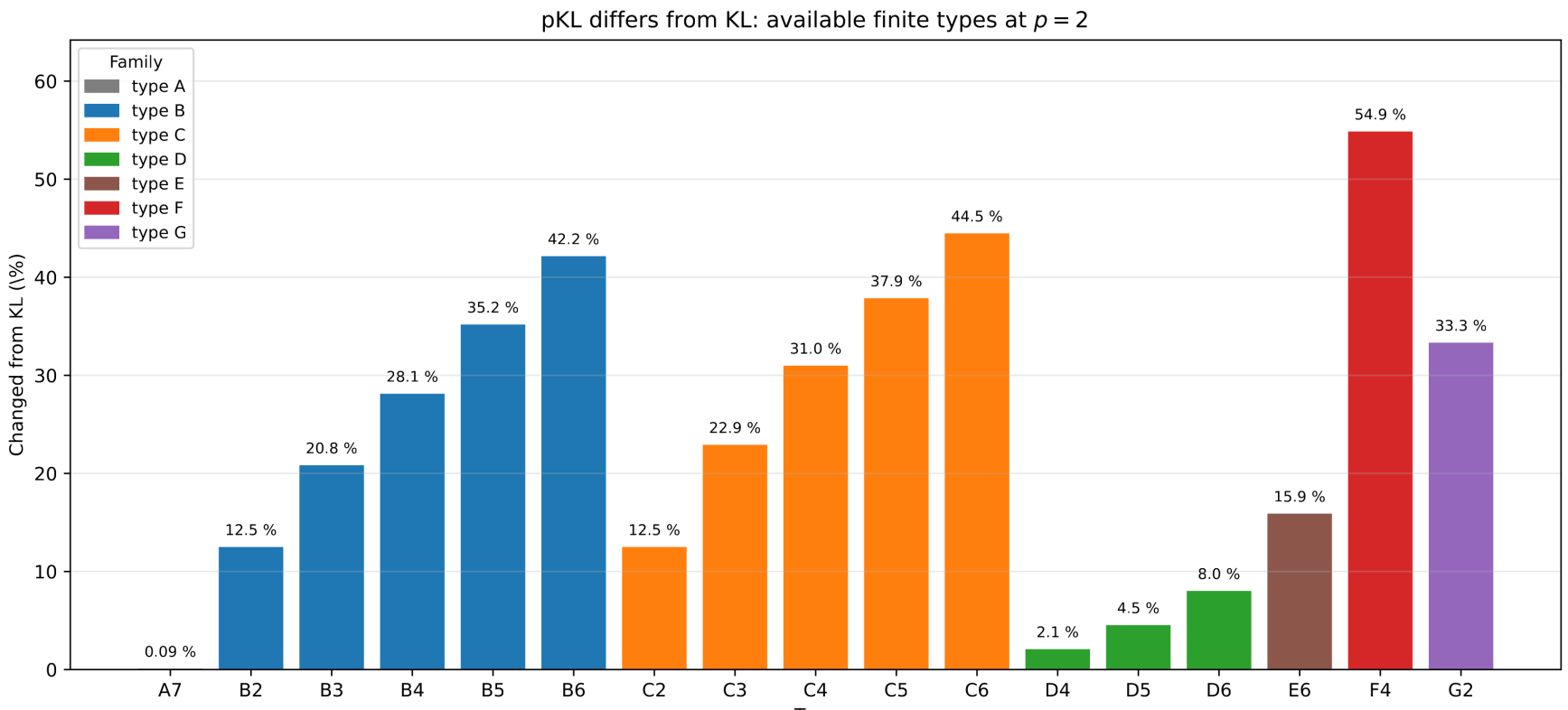
Available finite-type computations at \(p=2\). The colors indicate the Coxeter family.
Computational snapshot
The three ingredients
For every prime \(p\), type A supplies a seed with \(p\)-torsion, and a seed whose parity sheaf is not perverse.
Generalised interval pattern embeddings transport the corresponding local singularities into larger classical flag varieties.
In large rank these seeds occur with probability tending to one, and the complementary density decays exponentially.
A few extra words
The full-flag results are asymptotic, not sharp finite-rank predictions. The first ranks where \(p\)-torsion or non-perversity appear depend strongly on the prime and the type. The point is that once a finite bad seed exists, interval embeddings of that seed become overwhelmingly common in large rank.
Partial flag varieties add a useful warning: the limiting behaviour need not be the same as for full flags. For several natural families the paper computes explicit asymptotics, so the geometry of the parabolic quotient genuinely matters.
The accompanying computations show what already happens in small rank. Besides the percentage of changed elements, the data record correction size, graded corrections, length distributions, first witnesses, and several structural summaries. Most of this is too much for the paper, but it belongs on the GitHub page.