The Tambara–Yamagami calculus and finite semigroups
We ask what remains of the Tambara–Yamagami diagrammatic calculus when the finite group is replaced by a finite semigroup, and develop the resulting calculus.
Data
- Title: The Tambara–Yamagami calculus and finite semigroups
- Authors: Super Cao and Daniel Tubbenhauer
- Status: Preprint, 2026. Comments welcome.
- arXiv: https://arxiv.org/abs/2609.28957
- MSC 2020: Primary: 18M30, 20M50; Secondary: 18M05, 20M12.
Abstract
Tambara–Yamagami categories are among the simplest fusion categories beyond the pointed case: one adds a single noninvertible simple object to a finite group of invertible ones. We ask what remains of their (diagrammatic) calculus when the group is replaced by a finite semigroup, and develop the resulting (diagrammatic) calculus.
What is the point?
The ordinary Tambara–Yamagami rules start with a finite group of invertible simple objects and add one noninvertible simple object. Replacing the group by a semigroup sounds innocent, but the literal fusion rules immediately force the semigroup back to being a group.
The way out is to restrict the channels in the square of the extra object. Their support is forced to be a group ideal. In multiplicity one, ordinary Tambara–Yamagami data on this ideal extend to the surrounding semigroup through the canonical retraction onto the ideal. This gives a diagrammatic presentation, bases of morphism spaces, endomorphism algebras, and criteria for duality and braidings.
The first picture
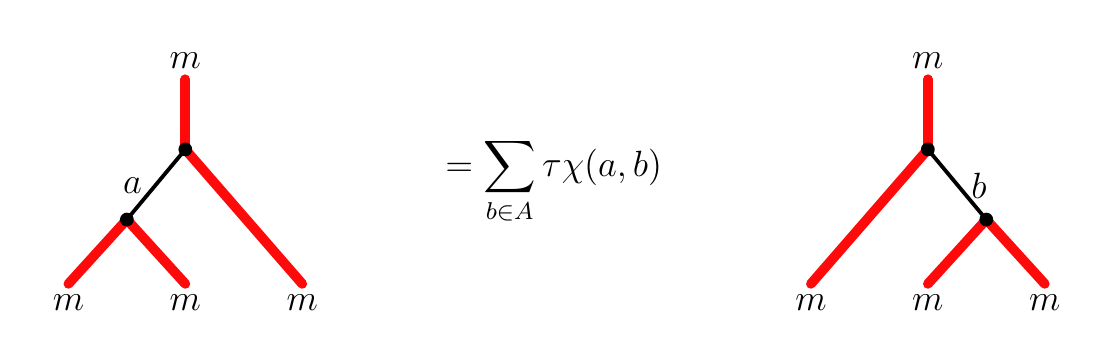
The central three-\(m\) recoupling relation: changing the fusion tree is a finite Fourier transform.
Structural snapshot
The three ingredients
The black strand calculus works for a finite semigroup and a 3-cocycle, just as pointed categories are governed by group data.
The red–red channels are forced onto a two-sided ideal which is itself a group, and the ambient semigroup retracts onto it.
The ordinary TY Fourier-type associators live locally on the ideal and extend to the ambient calculus by evaluating labels through the retraction.
A few extra words
The paper is deliberately diagrammatic. It gives generators and relations, fusion-tree bases for morphism spaces, and a direct description of the resulting endomorphism algebras. This makes clear which parts of the usual TY calculus really use inverses and which only use associative multiplication.
The ambient semigroup changes the global behavior. Cups and caps for the extra object use the identity of the local group ideal and therefore need not give ambient duals. Crossings can extend further, and the paper determines exactly when the local TY braiding extends.
There is also a second escape from the obstruction: keep all channels but allow reassociation to become noninvertible. The paper gives an idempotent-monoid example and leaves the broader skew-monoidal direction for later.