Annular webs and Guralnick's conjecture
First cohomology can be arbitrarily large, even for faithful absolutely irreducible modules of finite simple groups. A fixed annular web gives counterexamples to Guralnick's conjecture.
Data
- Title: Annular webs and Guralnick's conjecture
- Authors: Tom Goertzen, Abel Lacabanne, Daniel Tubbenhauer and Pedro Vaz
- Status: In progress (take with a grain of salt), 2026. Comments welcome.
- arXiv: TBA
- Journal: TBA
- DOI: TBA
- MSC 2020: Primary: 05E10, 20J06; Secondary: 18M30, 20C33.
Abstract
Using annular webs and Kazhdan–Lusztig mu-coefficients, we disprove Guralnick’s absolute boundedness conjecture for first cohomology.
What is the point?
Guralnick conjectured in 1986 that the dimension of first cohomology is bounded by one absolute constant for every finite group and every faithful absolutely irreducible module. The bound was supposed to work independently of the group, the field and the module dimension.
We construct modules for \(\mathrm{PSL}_{2m+1}(\mathbb F_p)\) with first cohomology dimension at least \(\lceil(m+1)/2\rceil\), for every \(m\geq 2\) and every sufficiently large prime \(p\). These dimensions grow without bound, disproving the conjecture. The required threshold for \(p\) may depend on \(m\).
The first picture
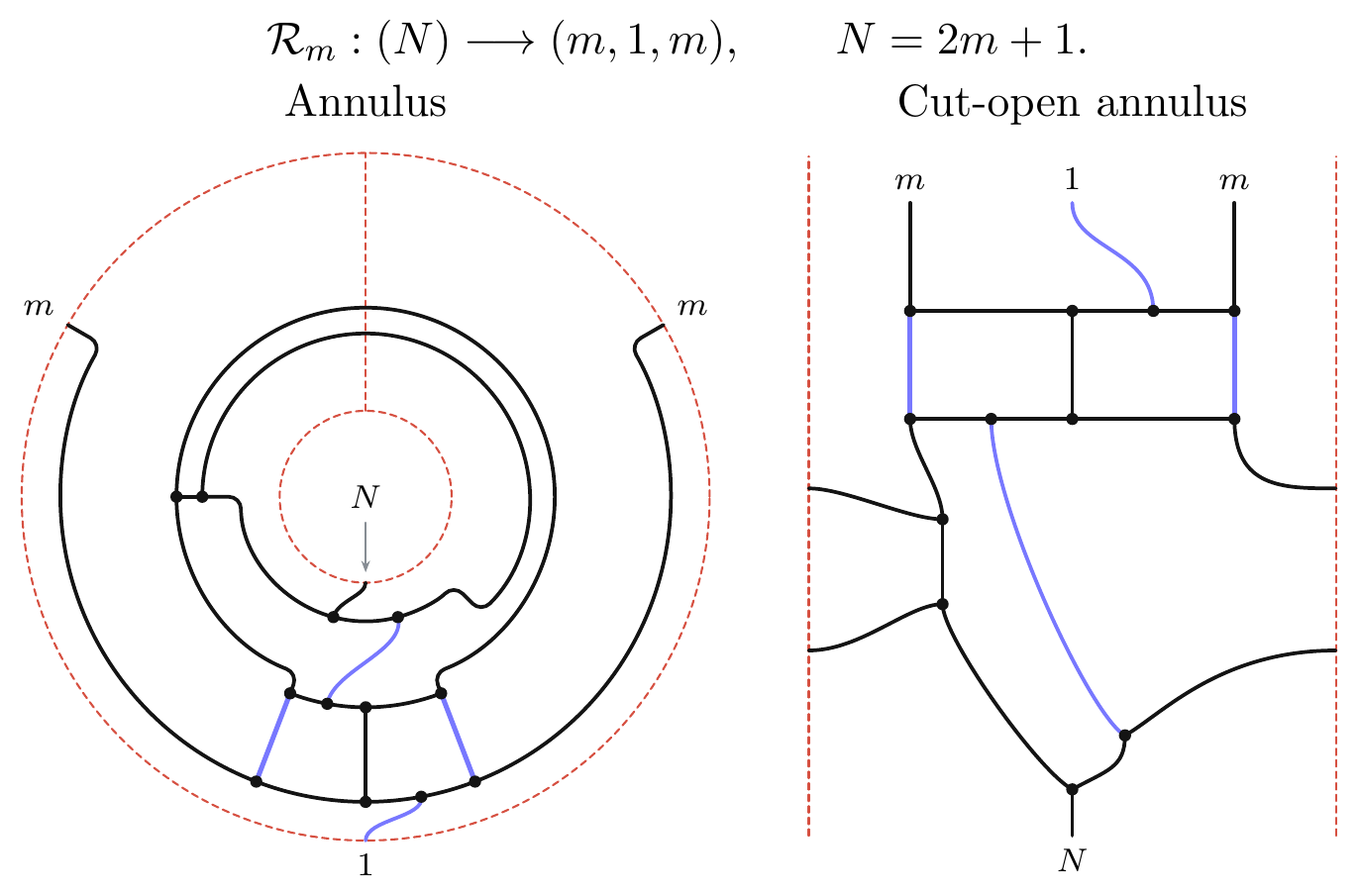
Figure 4 from the paper. The graph stays the same as \(m\) grows; only the edge thicknesses change. Glue the red dashed sides of the right-hand picture to recover the annulus. Click the picture to open the corresponding page of the PDF.
Structural snapshot
The three ingredients
Draw one small graph on an annulus. Increase the edge thicknesses while keeping the graph itself unchanged.
Count compatible sequences of subspaces to compute standard coefficients, then remove the lower canonical contributions. The corrected calculation gives the exact row sum \(m(m+1)/2\).
In sufficiently large characteristic, the relevant affine mu-coefficients are first cohomology dimensions. Averaging the row gives an unbounded lower bound.
A few extra words
The contrast with our earlier mu paper is striking: there we repeat planar web pieces, while here the graph stays fixed and only its thicknesses change. Its toroidal closure has the same numbers of vertices and edges as the Heawood graph, although the graphs are not isomorphic.
The theorem determines the row sum for every \(m\), without determining each individual coefficient. Computed rows for \(m=2,3,4,5\) are \((1,2)\), \((1,2,3)\), \((1,2,3,4)\) and \((1,2,3,4,5)\). They suggest the formula \(\mu_{j;m}=j\), but this remains open for general \(m\).
Code and extras
- Code: GitHub repository, with the Lean verification, exact Python computations, saved data and figures. The Lean formalization verifies the main algebraic and cohomological arguments relative to explicit hypotheses from the literature.
- Erratum: On GitHub.
- Theme song: TBA
- Talks and videos: TBA